Key Points
- House Bill 828, the Mississippi Fair Chase Act, faced widespread opposition from farmers, hunters and landowners who argued it would restrict protection of crops, property and hunting practices.
- The bill would require landowners to obtain depredation permits before hunting, trapping or taking game and furbearing animals that damage crops or property, and limit hunting with dogs to private properties of at least 2,000 contiguous acres.
- Mississippi Commissioner of Agriculture and Commerce Andy Gipson said on January 24 that House Wildlife, Fisheries and Parks Committee Chairman Bill Kinkade vowed the bill would die in committee.
- A Mississippi Wildlife Federation survey reported that, as of February 2, 361 out of 400 respondents did not support the Mississippi Fair Chase Act.
- The deadline for bills to make it out of committee is February 3, and House Bill 828 currently remains in the Wildlife, Fisheries and Parks committee.
PICAYUNE — A proposed wildlife bill in the Mississippi Legislature likely will not advance this session after widespread opposition from farmers, hunters and landowners who say it would restrict how they protect crops, property and traditional hunting practices.
House Bill 828, known as the Mississippi Fair Chase Act, would require landowners to obtain depredation permits before hunting, trapping or taking game and furbearing animals that damage crops or personal property. The bill would also limit hunting with dogs to private properties of at least 2,000 contiguous acres.
While the measure was introduced as a wildlife management proposal, critics say its language reaches far beyond a single hunting concern — prompting unity across farming, hunting and conservation groups that appears to have halted the bill.
According to Mississippi Commissioner of Agriculture and Commerce Andy Gipson, House Wildlife, Fisheries and Parks Committee Chairman Bill Kinkade vowed Jan. 24 that the bill would die in committee.
“The Mississippi Fair Chase Act would have stripped landowners, farmers and hunters of our rights,” Gipson said in a statement on Jan. 24. “Chairman Bill Kinkade informed me today that House Bill 828 will die in committee.”
Collective pushback
Supporters framed the bill as a response to conflicts involving deer dogs crossing onto private land. Opponents, however, said the bill’s wording would have affected far more than deer hunting.
David Smith, president of the Mississippi Hunting Dog Association, said language stating that “hunting with dogs is authorized only on private property” created confusion and could have been interpreted as banning dog hunting on public land altogether.
“The way they wrote it, it was like to stop all dog hunting on public land — which right now, the national forest is public land,” Smith said. “If you have to have 2,000 contiguous acres, rabbit hunters, bird hunters, coon hunters and squirrel hunters — they hunt on smaller acreages.”
Smith said groups that often operate independently — dog hunters, trappers, farmers and blood trackers — coordinated opposition to the legislation.
“This bill has also created a unified alliance, because … everybody is trying to unite every organization together to combat these kinds of bills,” he said.
On the farm
Concerns from those special interest groups extended into agriculture.
Current state law allows landowners to manage nuisance animals year-round, including beavers, coyotes, foxes, nutria, skunks and wild hogs. Critics said the bills depredation permit requirement created uncertainty about whether those protections would remain accessible.
Gipson publicly opposed the bill Jan. 20, warning it would harm farmers statewide.
“I am adamantly opposed to this legislation,” Gipson wrote. “House Bill 828 would strip our farmers and landowners of our God-given property rights. It would deny the freedom to protect our crops and lands and would hamstring landowners in our war against wild hogs.”
Brian Mills, a professor in Mississippi State University’s Department of Agricultural Economics, said a survey of 207 farmers showed deer — the main target of the bill — cause significant yield losses.
“(Respondents) said about 24 bushels per acre in yield loss, which if you know yield in Mississippi is around 60 (in total) for the state,” Mills said. “That’s about $258 to $259 per acre that they’re losing for soybeans.”
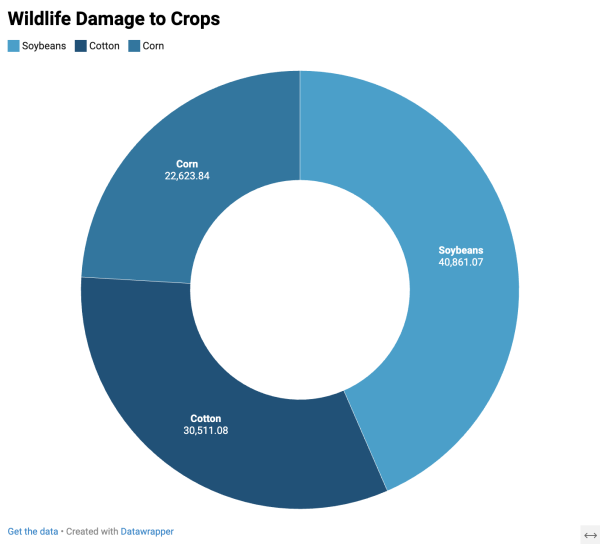
On average, soybean farmers who responded reported losses of about $40,000.
The survey also found that 48% of respondents managed deer damage by hunting themselves, while only 21% relied on deer depredation permits — meaning many would have needed new permits to continue existing practices under the bill.
Clarification from the bill’s author
Despite mounting criticism, the bill’s author, Rep. Justin Keen, said he sees the potential for common ground. He acknowledged concerns about the bill’s language in a public statement.
“There are a lot of misconceptions and misinformation floating around House Bill 828,” Keen wrote.
He said the intent was to start a conversation about deer dog conflicts on private land, not eliminate dog hunting.

“Dogs used for nuisance animals, animal recovery, small game and waterfowl etc., will and always be protected in my opinion,” Keen wrote. “That’s the intent of the bill although some of the language is vague. That’s my fault, and I take responsibility for that. I apologize for the confusion and there is specific clarity that will be amended to the bill should it move forward from our committee members and discussion.”
Despite promised clarity, public opposition remains strong. In an ongoing survey conducted by the Mississippi Wildlife Federation, 361 of 400 respondents have said, as of Feb. 2, they do not support the Mississippi Fair Chase Act.
House Bill 828 is currently in the Wildlife, Fisheries and Parks committee, who will decide whether the bill crosses back over to the house or dies in committee. The deadline for bills to make it out of committee is February 3.
RHCJC News contacted Rep. Justin Keen and Chairman Bill Kinkade for additional comment but did not receive a response by publication time.