Key Points
- The median age of Mississippi legislators is 57, while the state’s median age is 39.3.
- Millennials make up 22.8% of Mississippi’s population but only 7.4% of the House of Representatives, according to the Young Elected Leaders Project.
- Mississippi lawmakers earn a base salary of $23,500 per year and typically maintain careers outside government in a part-time legislature.
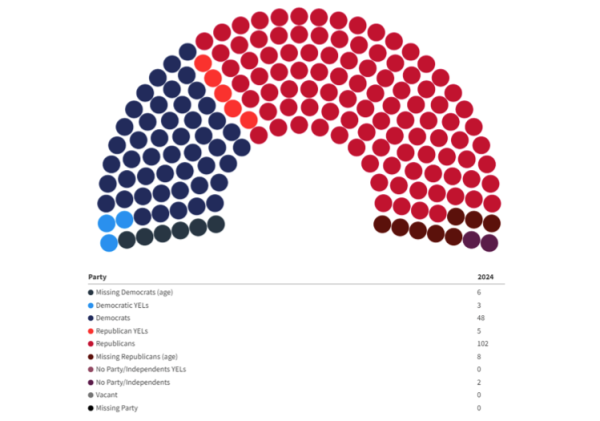
- The Young Elected Leaders Project identified eight Mississippi legislators younger than 35, compared with 68 legislators age 60 or older.
- Attorneys, business owners, executives, farmers, and retirees make up more than half of lawmakers’ occupations, according to the Legislature’s website biographies.
JACKSON — Mississippi’s lawmakers are significantly older than the people they represent, with the Legislature’s median age standing at 57 compared to the state’s median age of 39.3.
The age range among lawmakers stretches from 28-year-old Rep. Jimmy Fondren, R-Biloxi, to 84-year-old Rep. John Read, R-Gautier, whose districts border each other on the Mississippi Gulf Coast.
The gap is reflected in generational representation. Data from Rutgers University’s Young Elected Leaders Project shows millennials make up 22.8% of Mississippi’s population but only 7.4% of members of the Mississippi House of Representatives.
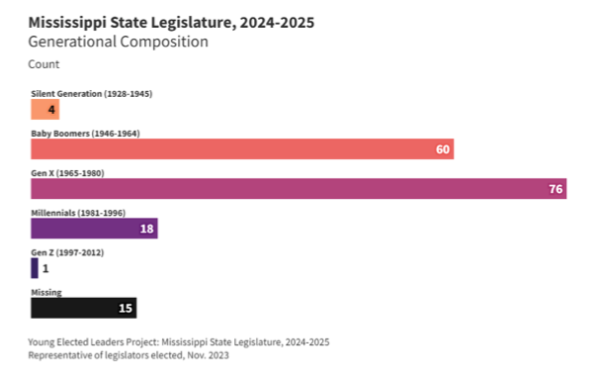
Rep. Justis Gibbs, D-Jackson, and George Quinn, a graduate researcher with the project, said the disparity reflects financial, professional and social barriers that can make public office harder to access for younger adults.
To Gibbs, one of the biggest obstacles is fundraising.
“You have to have money to run for office,” Gibbs said. “What that means is people have to believe in you enough to be able to reach into their pocket.”
Gibbs, who was elected to the House at age 28, said younger candidates often face skepticism because they have had less time to build careers, community connections and donor networks.
“Young people can’t say that they’ve done things for 30 years or for 40 years,” Gibbs said. “Young people are motivated. Young people are bringing new ideas to the table … Another barrier is convincing the community, our electorate, particularly in a state like Mississippi, to see those as advantages, not disadvantages.”

Gibbs acknowledged he entered politics with advantages. Both of his parents were elected officials, and his mother previously represented the district he now serves. Even with those connections, he said voters still questioned whether someone his age could effectively serve in office.
“Why should I have to wait until a certain age in order to give back to my community in that way, in a legislative way?” Gibbs said.
Part-time politics, part-time pay
Mississippi lawmakers earn a base salary of $23,500 per year in what is known as a citizen legislature, meaning legislators serve part-time and typically maintain careers outside government.
Quinn said that structure can make public office difficult for younger adults who are building careers, paying off debt or supporting families.
“I’m 26, so the first thing I’m looking at when I’m looking at a job is the pay,” Quinn said. “Many of us are just shell-shocked, and no, it’s not going to work on $25,000, $30,000 a year.”
According to the Massachusetts Institute of Technology’s Living Wage Calculator, a single adult in Mississippi needs an estimated annual income of more than $43,000 to meet basic living expenses.
Quinn said the demands of legislative service can also be difficult for people whose jobs offer limited flexibility.
“People who are 65 and older can afford to get paid $30,000 a year and do it,” Quinn said. “Somebody who’s in their 20s, 30s, 40s trying to raise a family may not have that access.”
Matt Steffy, a law professor at Mississippi Christian University, said those tradeoffs are built into the state’s constitutional framework. While well-paid legislatures may encourage career politicians, citizen legislatures such as Mississippi’s encourage people to pursue politics later in life after establishing careers outside government.
“The younger a person enters political life, the more likely politics is a career,” Steffy said. “Going back to the founding era of constitutional history, the idea is that politics should be a period of service, not a lifelong career aspiration.”
Steffy said some supporters of citizen legislatures view those features as intentional. Requiring legislators to maintain careers outside government, he said, can produce legislators with extensive professional experience and longstanding ties to their communities.
Legislative biographies published on the Mississippi Legislature’s website show attorneys, business owners and executives, farmers and retirees make up more than half of lawmakers’ occupations.
Supporters of the current model argue those backgrounds can provide expertise on issues ranging from business regulation and agriculture to the legal system, giving legislators practical experience outside government.
A 2025 Gallup study of more than 18,000 working Americans found that 62% reported having little or no control over their work schedules.
Quinn said younger people are not necessarily unwilling to run for office. Instead, he said, many face practical concerns that make other career paths more attractive.
“If I’m graduating from Ole Miss and I’m a political science major, I could go to law school, work on a campaign, work for a data firm, or do something that has a job pretty much ready to go when I graduate,” Quinn said. “Or I could run for office. That’s a gamble.”
Why representation matters
Gibbs said younger lawmakers can bring perspectives that might otherwise be missing from legislative discussions.
“There are some issues that I’ve brought up … that people will sit back in their chair and say, ‘I never thought of that,’” Gibbs said.
Advocates for older legislators, however, argue that age can bring institutional knowledge and a longer view of public policy, particularly when legislators have spent decades working in their professions or communities before taking office.
Steffy said age can bring wisdom and perspective to legislative discussions, and recency bias makes young people interpret events and others as unchanging.
“It causes us to exaggerate the differences with others. At least, as I have gotten older, I see more similarities than differences,” Steffy said.
Quinn said age diversity can influence how lawmakers approach issues affecting younger residents, including housing affordability, workforce development and emerging technologies.
“When we’re talking about affordability, talking about AI, talking about the big political hot topics today, we have people who are in their 60s and 70s dealing with those problems right now,” Quinn said. “Their view of things looks a lot differently than the view of people who are younger.”
Despite the disparity, both Quinn and Gibbs said they expect younger generations to become more involved in politics over time.
Quinn said national conversations about the age of elected leaders have increased interest in younger candidates across both political parties.
“When you have two successive presidents that have both beaten each other out for the oldest ever elected, it creates a lot of questions downstream,” Quinn said. “Definitely following 2024, there’s a lot more emphasis in both parties on wanting new generational change.”
Ultimately, Mississippi voters decide who serves in the Legislature. Candidates must win elections in their districts, and political observers note voters often favor candidates with established records in business, civic organizations or public service.
Gibbs said the goal is not to replace older lawmakers but to ensure the Legislature reflects a wider range of experiences and perspectives.
“Of course, there is a value of having folks who’ve been in a position for a long time, but a lot of times being older can sometimes lead to being stagnant or being stuck in the ways of how things should move or how things should work,” he said. “Having the younger group come in along with them can sometimes push us to having even better bills, better legislation and more success for the state.”