Go into any jewelry store around Southeast Mississippi, and you’ll see hundreds of sparkling diamonds. You might know the 4Cs of diamond shopping – color, cut, clarity and carat, but do you know the difference between a natural diamond and one grown in a lab?
The Roy Howard Community Journalism Center’s “What is True?” team investigated claims circulating on social media that lab-grown diamonds are different than natural diamonds. Are lab-grown diamonds less valuable but more ethical than natural ones?
RESULTS: Misleading Claims

How are lab-grown diamonds made?
Diamonds of any kind are made up of only one element, which is carbon. While other materials, such as coal and graphite, are also composed of carbon, the differences in texture and appearance are due to the placement of carbon atoms. The high pressure at which diamonds form causes the atomic bonds to become so tight that the resulting materials become transparent.
Both natural diamonds and lab-grown diamonds need somewhat similar conditions to exist. The main difference is how they grow. Natural diamonds take around 3 billion years to form in the Earth’s crust, causing the gems to have unique impurities. Lab-grown diamonds, however, are created over a short time in a controlled environment using high-pressure, high-temperature (HPHT) or chemical vapor deposition (CVD). The controlled environment results in uniform quality with minimal impurities.
Lee Chambliss, operations manager at Parris Jewelers, said that lab-grown diamonds are purer than natural diamonds. He explained that this is because natural diamonds can be affected by whatever is around them when they form. For example, recrystallization of other stones can occur.
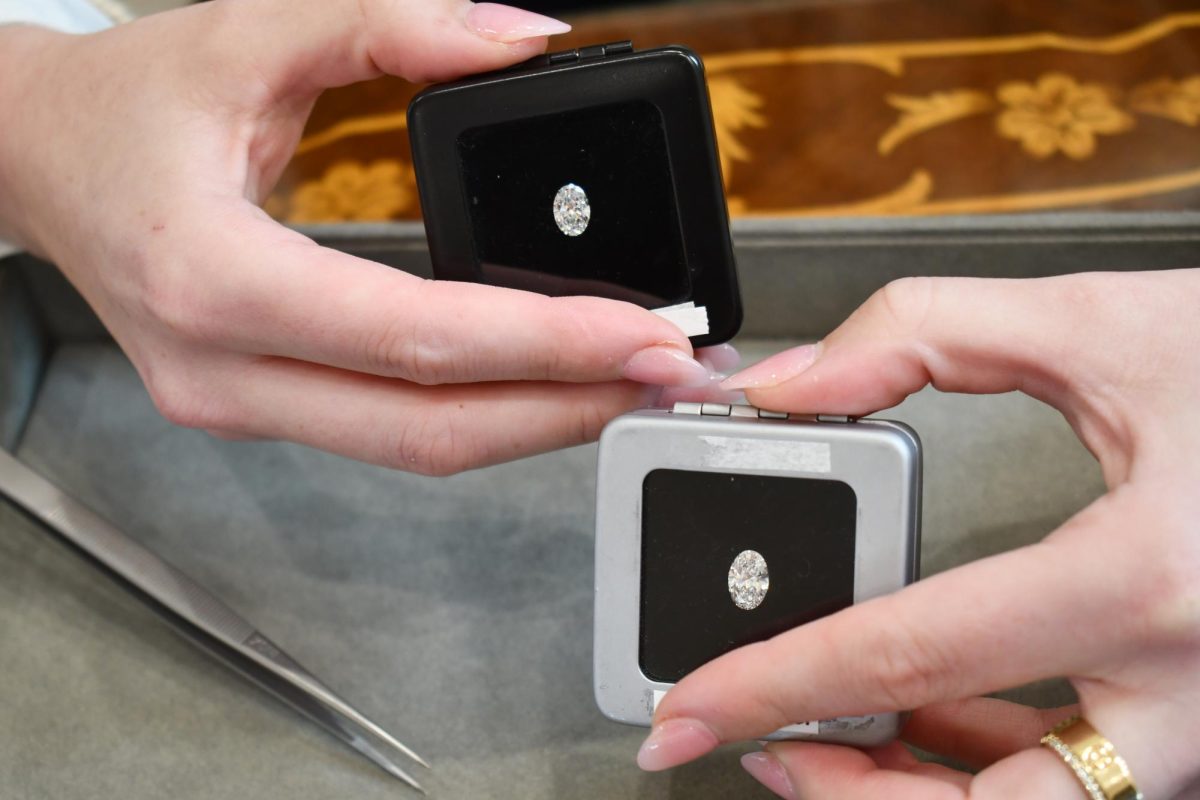
“I’ve seen diamonds where it’s had a sapphire or ruby that has actually crystallized inside of it,” said Chambliss.
Colored diamonds are another example. Yellow, pink and other tinted diamonds are formed by the presence of chemicals other than carbon inside the gem.
Other than impurity, natural diamonds and lab-grown diamonds are chemically the same. It’s the microscopic planes that determine the atomic structural difference between lab-grown and natural. Natural diamonds have octahedral atom structures. Alternatively, lab-grown diamonds will have either atomic structures with cubic faces (HPHT) or a flat tabular shape (CVD). Generally, no one will notice these differences except a geologist or a professional jeweler.
Which type of diamond is worth more?
Although natural and lab-grown diamonds are chemically identical, they differ significantly in cost. Lab-grown diamonds are much cheaper. Chambliss said this difference is due to the lab-grown diamonds being mass-produced for wholesale.
The resale value for diamonds goes down regardless of whether it’s lab-grown or natural. According to an article by Gem Jewelers Co, natural diamonds can typically be resold for 20-60% of their original price, while lab-grown diamonds can only be resold for 10-30% of their original price. The percentage difference is largely due to historical significance and the market.
Chambliss had a helpful piece of advice for people looking to buy diamonds or jewelry in general.
“Buy it because you like it,” he said.
Are lab-grown diamonds more ethical than natural ones?
Another misconception about natural diamonds is that they are unethical to mine, i.e. blood diamonds, meaning it’s more ethical to buy lab-grown diamonds. Chambliss, however, said this isn’t the case due to the Kimberly Process.
Gem Breakfast defines ethical diamonds as those sourced, processed and sold in a manner that prioritizes human rights, environmental concerns and local communities. The diamonds must also be conflict-free – not used to fund wars, rebels or terrorism.
Chambliss explained that the Kimberly Process is a commitment to remove conflict diamonds from the global supply chain. It enforces certification protocols and compliance assessments.
Summary:
Are natural diamonds and lab-grown the same thing?
Chemically they are the same, but structurally they are different. These microscopic differences are why people say you cannot tell the difference unless you are a professional who knows how to tell the structural differences through a microscope.
Are lab-grown diamonds more ethically sourced than natural diamonds?
No, natural diamonds sold on the global market must now adhere to the Kimberly Process, which is a set of regulations and rigorous protocols to ensure that the diamonds people purchase are conflict-free.
What is the value difference?
The value difference between natural diamonds and lab-grown diamonds comes down to the market. Lab-grown diamonds are being mass-produced at such a fast rate that their value isn’t as significant as natural diamonds that were grown by the earth over 3 billion years.