Key Points
- Mississippi schools are entering the 2025-26 school year under a new accountability system that raises the score cutoff for districts to earn an A rating by 15 points.
- The 2025-26 school grades, set to be released in fall 2026, will establish a new baseline for future comparisons under the revised system.
- Lamar County, Pearl River County, and Gulfport school districts would fall short of the new A threshold by 1, 3, and 5 points respectively if their scores stay the same as last year.
- Elementary/middle schools must now earn 457 of 700 points and high schools 769 of 1,000 points for an A, with the percentage of A-rated districts projected to drop from 36.1% to 21.4%.
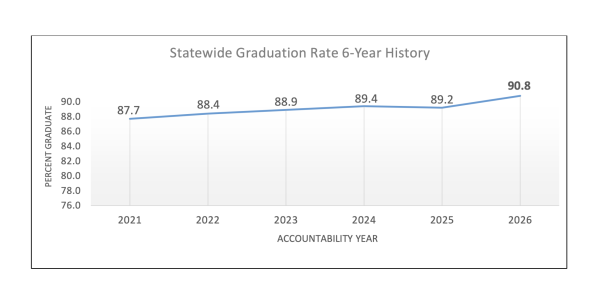
- The accountability system awards points for proficiency and growth in core subjects, as well as acceleration, college- and career-readiness, participation, and graduation rates.
MISSISSIPPI — As Mississippi schools close out the 2025-26 school year, some districts are near a new accountability threshold that could lower their letter grades when results are released this fall. This is the first school year under the revised system, which raised the district cutoff for an A by 15 points. State reporting says the 2025-26 grades will be released in fall 2026 and will set a new baseline for future comparisons.
The change moves Mississippi away from a model in which a set number of districts end up in each grade band and toward one that works more like other states’ systems. The state now sets score thresholds for each letter grade, and districts are judged against those thresholds instead of against one another for a limited number of A’s or B’s.

Under the new cutoff, several districts that earned A ratings in the 2025 Mississippi Statewide Accountability System results for the 2024-25 school year would drop to a B if they posted the same scores in 2025-26. Lamar County School District would miss the new A threshold by 1 point, Pearl River County School District by 3 points and Gulfport School District by 5 points.
According to the Mississippi Department of Education, the higher standards are part of a required reset in the state’s accountability system. Under state policy, standards must increase when proficiency exceeds 75% or when at least 65% of schools or districts earn a B or higher. State officials said that threshold was reached in 2023, triggering the reset process for the current accountability cycle, although implementation was delayed because of leadership changes. Once Lance Evans began serving as state superintendent in July 2024, MDE said the tougher grading rules were applied beginning with the 2025-26 school year.
Evans said the reset does not create a new test or resume. Instead, it changes the cut scores used to assign A-F ratings. Elementary and middle schools now must earn 457 points on a 700-point scale to receive an A, up 15 points from the previous cutoff. For high schools, the A cutoff also rose by 15 points, to 769 on a 1,000-point scale. State planning documents project that, under the higher district cut scores, the share of districts earning an A would drop from 36.1% to 21.4%.
For rural districts such as George County, educators said the transition adds another layer of strain. George County School District earned a B in the 2025 Mississippi Statewide Accountability System results for the 2024-25 school year. The district’s score of 658 left it 10 points short of an A under the previous model. If George County posts the same score in 2025-26, it would sit 36 points below the new A cutoff of 694.
George County High School Principal James Holland said his school had limited time to respond once the higher standards were finalized — about a month before the start of the school year in which they would be applied.
“We got word about the change kind of at the end of last school year or this past summer,” Holland said. “We made some adjustments in that short time frame.”
The system awards points for proficiency and growth in reading, mathematics, history and science. Districts can also earn points for acceleration, college- and career-readiness, participation and graduation rates.
To improve their rating, Holland said George County focused on college-readiness measures.
“ACT has been important, but now it’s even more important,” Holland said. “Each class is supposed to have a small section, at least, of ACT prep.”

Erica Jones, executive director of the Mississippi Association of Educators, said state leaders, educators and parents need to understand the new system and the limitations smaller districts face in meeting higher benchmarks.
“We have to be mindful that our districts that don’t have all of the resources of some of our larger school districts may not have an even playing field,” Jones said.
Darein Spann, a former high school English teacher, current Starkville High School administrator and president of the MAE, said accountability pressure can shape how the public reads school performance. Starkville-Oktibbeha Consolidated School District scored 679 in the 2025 district results, which is above the old A cutoff but below the new 694-point mark.
He said transparency is important to ensure the new results, which will be released this fall, are not out of context and that teachers continue to be taken.
“Teachers work hard every day across this state and go to work to ensure that they meet those accountability standards to show increase,” Spann said. “But where they don’t or where they fall short is my concern, or where politicians may try to use that as a negative for public schools.”