Key Points
- The Moss Point School District reported that 44% of its students missed at least 10% of the 2024-25 school year, leading the state in chronic absenteeism.
- Statewide chronic absenteeism in Mississippi public schools increased from 13% in 2018-19 to nearly 28% in 2024-25, impacting 120,408 students.
- The Mississippi Department of Education plans to propose updates to the Compulsory School Attendance Law, including modernizing enrollment cutoff dates and requiring action plans when chronic absence exceeds 10%.
- MDE officials discussed raising the average salary for attendance officers from about $31,000 to $40,000 and rebranding them as “student success coaches.”
- Moss Point is auditing attendance codes, strengthening early-warning alerts for families, and implementing a three-tier model with incentives and intensive supports for students with higher needs.
MOSS POINT — In his Moss Point School District office, Superintendent Christopher Williams reflected on the Mississippi’s latest chronic absenteeism report, which shows 44% of his students missed at least 10% — roughly 18 days — of last school year.
“We are leading the state in the percentage of our students who are chronically absent,” Williams said. “We’re looking at what we can do to combat what we know to be a problem.”

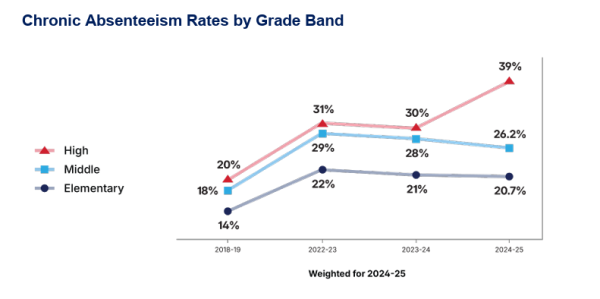
Statewide, chronic absenteeism rose from 13% in 2018-19 to nearly 28% in 2024-25, affecting 120,408 students. After another year above pre-pandemic levels, state officials say it’s time to press for solutions.
What’s causing high rates?
The Mississippi Department of Education uses the federal definition for chronic absenteeism: missing 10% of the school year for any reason. MDE officials said Mississippi also requires students to attend 63% of the school day — higher than the 51% threshold in many states.
Attendance Works, a national group, cites four broad causes of chronic absence: barriers such as illness, transportation or housing; aversion to school; disengagement; and misconceptions that missing a few days won’t matter.
Williams said Moss Point is still identifying why its rate is so high, but early conversations point to a mix of family perceptions of schooling, student disengagement and individual barriers such as physical or mental health or transportation.

“Part of the work that we’ve engaged in is trying to identify what is causing this high number … bringing attention to these rates and (understanding), ‘What are the implications for them?'” Williams said.
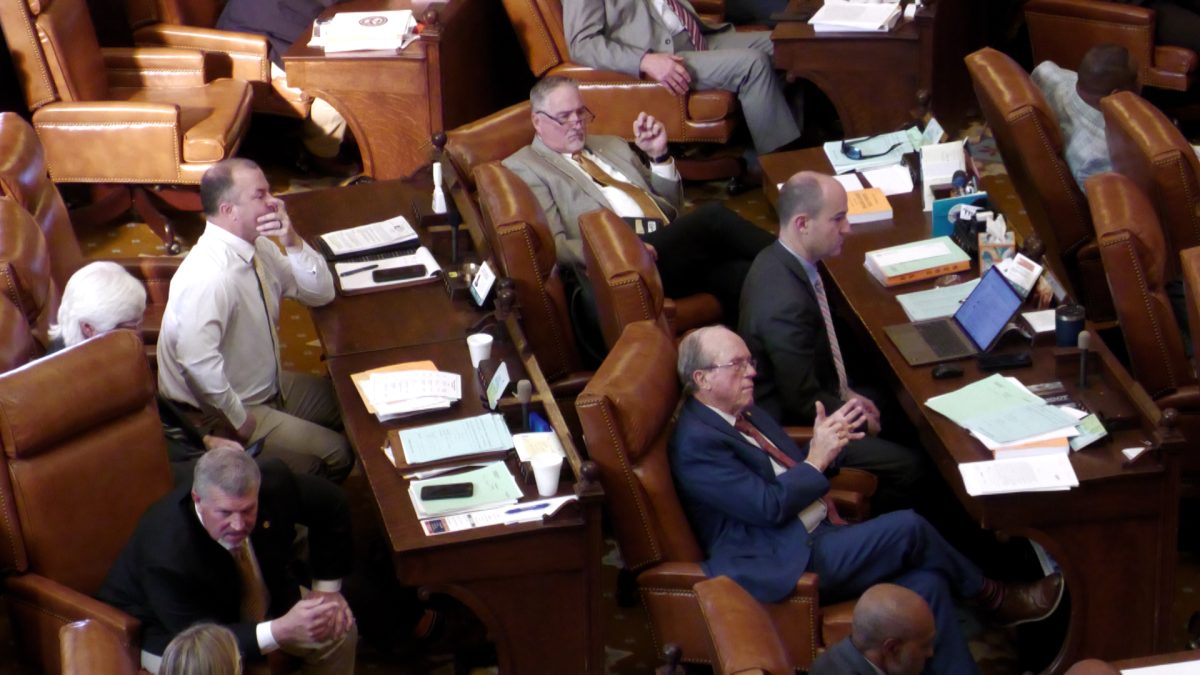
During an Oct. 10 Senate Education Committee hearing, state officials said roughly one-third of last year’s absences were excused and that absences spike before breaks and exams. Smaller schools in high-poverty communities also see higher rates.
Mississippi’s highest rates were in high school. Robert Peters of the National Dropout Prevention Center said schools often “see the fever in high school,” but the symptoms start earlier, in grades 5-7, as students start to disconnect. He said building relationships with students is key.
“The best high schools … connect with the children in middle school, and as soon as they get to high school, they’ve already surveyed those children and know exactly what they like; they’ve looked at the instructional data to know exactly where they are,” he said.
Associate State Superintendent Bryan Marshall said students who are not in class miss instruction and fall behind. MDE officials told senators chronic absenteeism rates between “25% and 30% hurts graduation rates, jobs and safety.”
How the state is responding
Marshall said the department plans to propose updates to Mississippi’s Compulsory School Attendance Law to help districts better determine when students are present and absent. One example is modernizing the enrollment cutoff date.
“There’s some language in those laws that … goes back to a different time,” he said. “It’s time to change some of that, to help address the attendance issue.”
Marshall noted that at five unlawful absences, a student is truant, and after 12 a youth-court petition may be filed. Truancy only counts unexcused absences and relies on legal responses such as fines.

In the Senate hearing, officials outlined a shift away from a court-first approach toward earlier supports and several system changes:
— Requiring attendance action plans when chronic absence exceeds 10%, with family supports before Youth Court involvement.
— Creating a public, daily attendance dashboard so schools and families can track patterns.
— Pairing attendance work with a K-3 family-engagement push and targeted grade-level supports.
Marshall said the department also wants uniform attendance coding to ensure accurate data.
“We are working toward moving our state from a punitive system to a restorative practice and proactive system … versus a reactive system,” he said.
Attendance officers
MDE officials also discussed rebranding state-employed attendance officers as “student success coaches,” focused on proactive family outreach. Attendance officers enforce the state attendance law, support dropout prevention and conduct home visits.
The Senate has echoed that focus. Lt. Gov. Delbert Hosemann has called for raising salaries, lowering the minimum credential to an associate degree and placing additional officers in every district.
Sen. Scott DeLano, R-Harrison County, member of the education committee, said officers in his area are stretched thin.
“We may have one truancy officer that’s supposed to be responsible for, say, 12,000 kids … there’s no way they could keep that up,” he said.
Marshall said the starting salary is $24,500, which makes hiring difficult. MDE recommended raising the average salary to $40,000, up from the current average salary of about $31,000.
If changes move forward, Marshall said the role will focus more on breaking barriers to student attendance and reducing youth-court involvement.
“For a long time, attendance in schools has been looked at as something separate from a behavioral issue or from a barrier issue,” he said. “It’s time for us to start doing some things differently‚ and to find out what barriers are in place that are keeping kids from coming to school.”

What’s next for Moss Point
Moss Point is auditing attendance codes — including late check-ins and partial-day absences — so interventions target students truly missing instruction. Staff are strengthening early-warning alerts so families get timely notice.
Williams said the district is building a three-tier model: stronger school-wide expectations and incentives; personalized outreach and transportation solutions when absences begin; and intensive services for students with bigger needs, including a day-treatment partnership with South Mississippi Mental Health.
Students on his advisory council told him some classmates don’t always feel connected at school — something he believes schools can influence.
“We have to make sure that we look at those students who may be a grade level behind or two grade levels behind — that we’re giving them inspiration and hope — that we have programs in place that can catch them up,” Williams said.
Williams said Moss Point holds monthly problem-solving meetings to review attendance reports and assign outreach steps. The district will continue meeting with youth court to explore options that address “root causes.”
“Because taking a punitive approach is not working,” he said. “We are certainly open to any and all suggestions that could help us combat this problem, and when we get it right, the community wins, and when we get it right as a state, the state wins.”