Key Points
- REACH MS is a $2.2 million live online learning program in Mississippi that connects certified teachers from Mississippi Public Broadcasting studios to classrooms lacking certified staff, launching in August.
- About 185 students across five districts—Hinds County, Yazoo County, Yazoo City, Claiborne, and West Point—are enrolled in the pilot semester, taking classes like Algebra I through daily livestreamed lessons.
- The program provides the tools, teachers, and grading, while schools offer an in-room facilitator, handle grade entry, and meet special education requirements.
- Raymond High’s Algebra students using REACH MS outperformed some traditional classes on the first nine-week benchmark assessments, according to Principal Charles Willis.
- The program plans to expand in spring to more courses and schools, including Moss Point High School, with 12 teachers—six certified and six interns—each instructing up to 450 students next semester.
JACKSON — When the bell rings at Raymond High School, the Algebra I teacher doesn’t walk through the door. Instead, he appears on a screen, writing formulas in neon ink across a pane of glass miles away in Jackson. Today’s lesson: the quadratic formula. Students call out steps to math problems as they follow along on school laptops.
“For me, it takes a long time for me to process (math),” said ninth grader Brayden Tucker. “With him writing it down, I can just see it, and I understand it better.”

This is one of Mississippi’s newest solutions to its teacher shortage: a live, online learning program called REACH MS — or the Mississippi Virtual Synchronous Learning Initiative. It connects certified teachers from Mississippi Public Broadcasting studios to classrooms that otherwise might not have one — and plans expansion to more schools in January.
REACH MS connects teachers, classrooms
Since the $2.2 million pilot program launched in August, Raymond’s Algebra I students have adjusted to the new setup. Principal Charles Willis said the school joined because of four math teacher vacancies.
“We really needed someone to help us out with algebra because this is a tested subject, and these kids needed to graduate,” Willis said.
Associate State Superintendent Bryan Marshall said REACH MS targets districts lacking certified teachers — a widespread problem in Mississippi, where the Department of Education reports more than 5,000 vacancies.

“People just aren’t going into education like they were in the past, so we need all the educators we can get,” Marshall said. “(The program) is literally squeezing a dollar out of a nickel — and it is different from the mindset of a regular classroom with a teacher and 25 kids.”
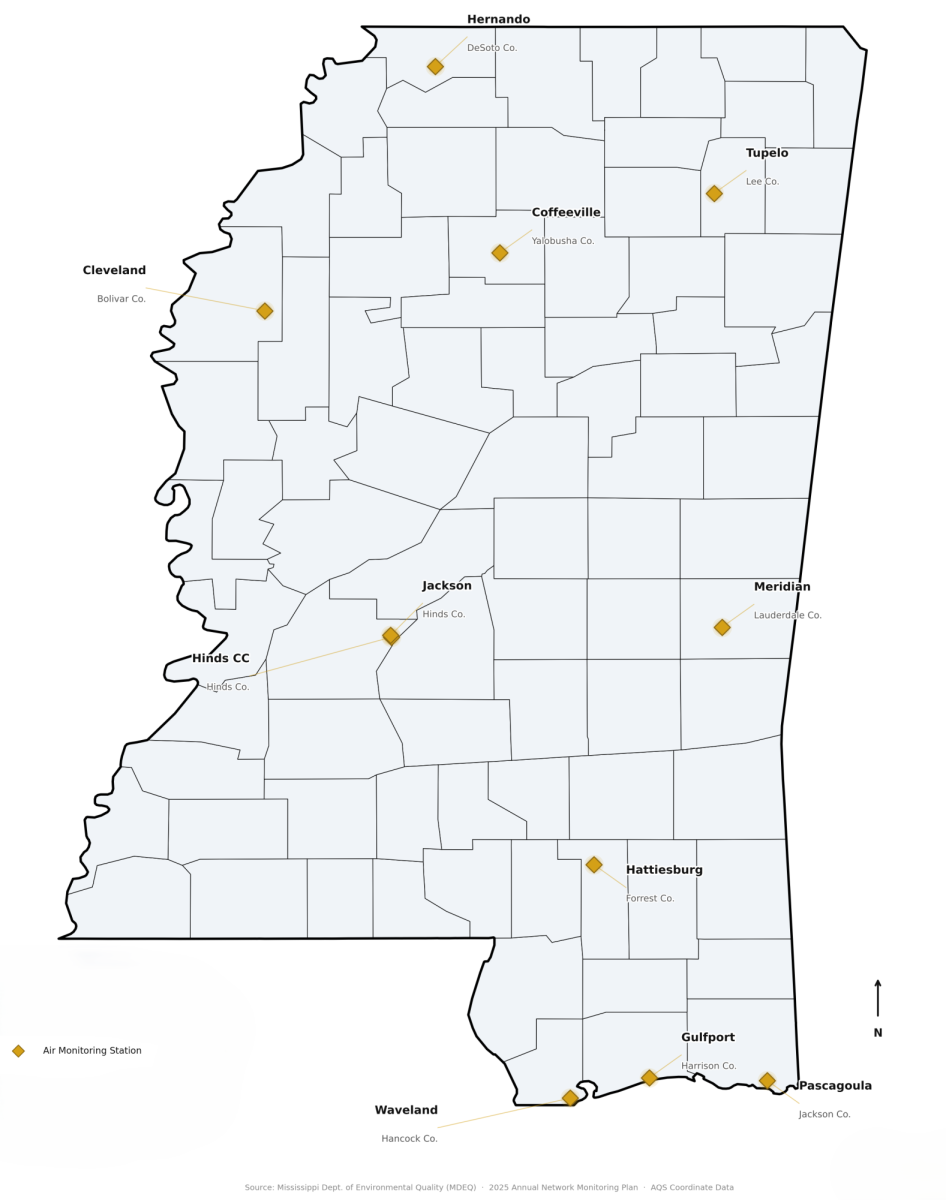
About 185 students across five districts — Hinds County, Yazoo County, Yazoo City, Claiborne and West Point — are enrolled this semester. Schools choose class times that fit their schedule and log on daily.
The program is designed to help schools host classes even without a livestreaming setup. REACH MS supplies the tools, teachers and handles grading, while schools provide a facilitator, enter grades and meet special education requirements.
Marshall said two factors distinguish REACH MS from COVID-era remote learning: on-site facilitators and the use of eGlass, a digital whiteboard that lets teachers present lessons live.
Early results show success
Raymond High algebra teacher Brendin Snow, one of two student interns teaching from MPB, said once students adjusted to the digital structure, their progress improved.
“You have to lay the groundwork of how this works because a lot of these kids have never worked fully online,” Snow said. “You have them submit their own work, written and everything … and they understand what they need to do to succeed.”
After wiping down the eGlass and waving goodbye to Raymond High, Snow prepares for his Algebra II section, which livestreams to three different schools simultaneously. Facilitators relay classroom questions through chat to manage the larger groups.

“I don’t think the program would be possible without the facilitators,” Snow said. “They’re there managing that technology, helping us hop on Teams every morning — they’re there making sure the students don’t act up.”
Willis reported strong early results, with REACH Algebra students outperforming some traditional classes on first nine-week benchmarks. He said the program’s value is clear: more schools and students have access to qualified teachers.
“The parents have adapted to it,” Willis said. “It’s way better than hearing that your child doesn’t have a certified teacher.”
Schools statewide eye expansion
Currently, the program offers English I, English III, Algebra I and Algebra II. Spring expansion is expected to add Geometry, Foundations of Biology, Biology I and Biology, though offerings could shift based on statewide needs.
New eGlass classrooms are already under construction at MPB, with positions open for teachers. Next semester, 12 teachers — six certified and six interns — will each instruct up to 450 students.
Marshall said the focus on interns helps strengthen the teacher pipeline.
“We would love for them to be with us in the fall as an intern, be a full-time teacher in the spring, and then maybe venture out on their own after that,” he said.

Moss Point School District, one of more than 100 Mississippi districts in “critical shortage areas,” will join next semester.
Director of Curriculum David Graves said Moss Point High School has faced ongoing teacher shortages since the COVID-19 pandemic, moving year to year with at least two vacancies in state-tested subjects. This year, there are five vacancies in tested subjects and seven overall.
The district’s math and English proficiency rates lagged behind the state average last year. Math proficiency fell short of the average by about 17 percentage points, and English by about 14 points.
“When we don’t have personnel, we have to have higher numbers in the classroom,” Graves said. “The higher number you have of students in the classroom, it could be more challenging so far as to give the students what they need … especially if you have students who are considered struggling.”
Moss Point has met all REACH MS requirements and is waiting for MPB teachers to go live next semester with English and algebra courses to reduce class sizes. Graves said the district has worked creatively to close learning gaps, using after-school and intersession programs to boost proficiency. The district rose from a D rating in 2020-21 to a B last year, with above-average growth in math and English among low-performing students.
He’s eager to see the REACH MS teacher log on and continue the progress.
“I’m pleased to see our state support us this way,” Graves said. “I commend them on doing that and not leaving us to our own devices to fix the problem, but they’re actually offering a solution.”