The Roy Howard Community Journalism Center’s “What Is True?” team investigated a claim circulating on Reddit that Saharan dust makes the southern United States less humid.
RESULT: Misleading.
While Saharan dust can influence weather conditions, it is not a primary driver of humidity. The amount of moisture in the air depends mainly on water vapor, temperature and the movement of air masses. Saharan dust can suppress thunderstorms and slightly lower daytime temperatures, but it does not typically reduce humidity on its own. Read the full fact-check below:
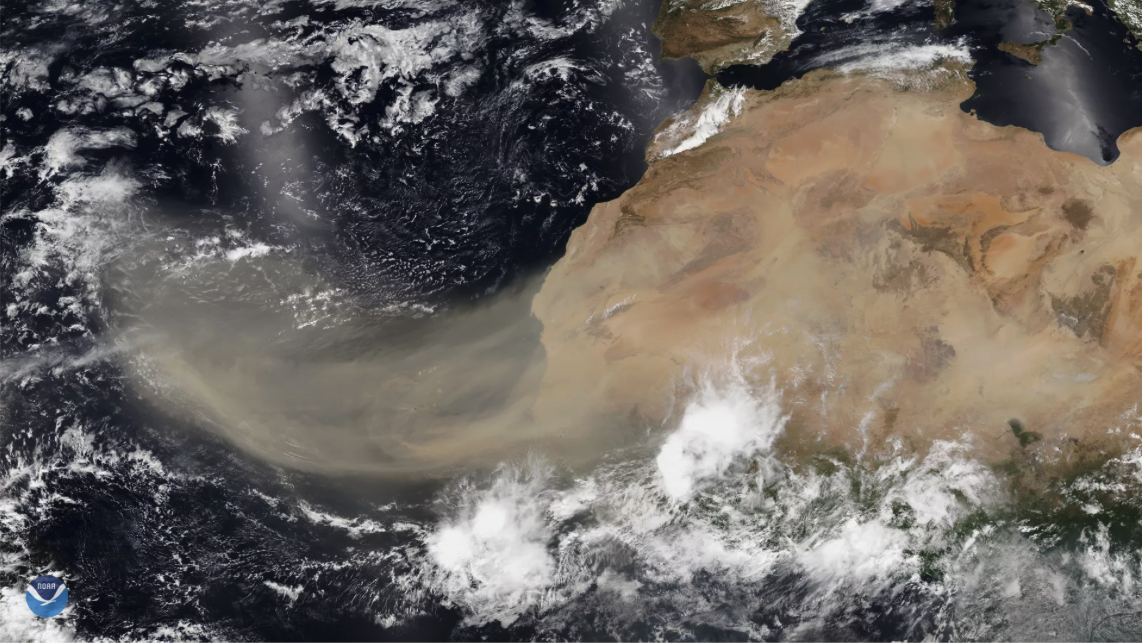
Saharan dust consists of fine mineral particles carried from the Sahara Desert in North Africa. According to Dave Hill, lead meteorologist at the National Weather Service office in Shreveport, Louisiana, strong winds lift the dust high into the atmosphere, where trade winds carry it across the Atlantic Ocean toward the Caribbean and the Gulf Coast.
Meteorologists refer to this mass of hot, dry, dusty air as the Saharan Air Layer. According to The Weather Channel, Saharan dust most commonly reaches the Gulf Coast during the summer, with the greatest activity typically occurring from June through August. Dust plumes can arrive every few every three to five days during active periods.
Hill said a small Saharan dust plume reached south Mississippi on the morning of June 29 but moved out of the area quickly. During that event, local observations showed dew points increased after the dust arrived, illustrating that Saharan dust alone does not determine humidity. Hill said that if the dust plume had been thicker, it might have lowered daytime temperatures enough to reduce the heat index, even if the amount of moisture in the air remained about the same.
The distinction is important because humidity and heat are not the same thing. A lower air temperature can make conditions feel more comfortable even when humidity remains high. Likewise, a hot day can feel even hotter when high humidity limits the body’s ability to cool itself through evaporation.
According to the University of Miami, the Saharan Air Layer suppresses convection, the rising motion of warm air that helps thunderstorms develop. By reducing cloud formation and rainfall, the dust layer can change local weather patterns. While the dust can block some sunlight and slightly cool the surface, it does not necessarily remove moisture from the air. In some situations, moisture can remain concentrated near the surface, leaving conditions feeling hot and humid despite the presence of Saharan dust.
The American Lung Association also advises that Saharan dust can reduce air quality and may worsen symptoms for people with asthma, chronic obstructive pulmonary disease and other respiratory conditions. The organization recommends the following precautions during high-dust events:
— Stay indoors when possible.
— Wear a high-quality mask if spending time outdoors.
— Use a HEPA air filter indoors.
— Monitor respiratory symptoms.
— Contact a health care provider if symptoms worsen.
About “What Is True?”
The RHCJC “What Is True?” team investigates claims ranging from viral social media posts to local community rumors. If you have a question you’d like the team to investigate, submit it through the “What Is True?” inquiry formon the RHCJC website or call 855-IS-IT-TRU (855-474-8878).